Saturday, March 30, 2019

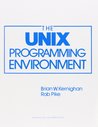
Review: The UNIX Programming Environment

The UNIX Programming Environment The UNIX Programming Environment by Brian W. Kernighan
My rating: 0 of 5 stars

This book, copyright 1984, is not one's typical software read. Typical books on software deal with the latest and greatest that's coming down the pike. Instead, this book is a reminder of what is great in the UNIX operating system. It harkens back to the days when assembly coding was common and programming in C was considered more cutting edge.

So why is this worth a programmer's time to read over thirty years later in an era of object-orientation and machine-learning? The answer to this question is not vexing; indeed, it is simple. Great ideas transformed into great inventions deserve great study.

This book's epilog sums up this advice in describing four elements of UNIX's style:

1. "Let the machine do the work."
2. "Let other people do the work. Use programs that already exist as building blocks in your programs..."
3. "Do the job in stages. Build the simplest thing that will be useful, and let your experience with that determine what (if anything) is worth doing next."
4. "Build tools. Write programs that mesh with the existing environment, enhancing it rather than merely adding to it."

View all my reviews

Thursday, March 28, 2019

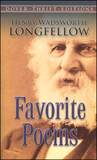
Review: Favorite Poems

Favorite Poems Favorite Poems by Henry Wadsworth Longfellow
My rating: 4 of 5 stars

I picked up this collection of Longfellow's poetry because I SHOULD know more about one of America's all-time greatest poets. I write poetry; I love dissecting poetry; I SHOULD know more about Longfellow.

While reading, I came to know his clear and entertaining style. I came to appreciate how he can "spin yarn" (tell stories) effectively and efficiently. Whether he is writing in rhyme or in meter, he has the right word coming forth.

This collection contains one poem that is over 30 pages long. Other poems are much shorter, usually 1-2 pages in length. All these works are worth reading. The breadth of topics covered is quite impressive. Longfellow obviously had a supple and fertile mind and life. I can envy that he was able to make a life from poetry.

I am inspired to read more of his classic works. I gave this present work four stars instead of five because of what it omits. This collection contains his famous poem about Paul Revere, but misses some other classics such as The Song of Hiawatha and Evangeline. I am likewise inspired to read his poems on slavery as this is a particular interest of mine.

View all my reviews

Wednesday, March 27, 2019

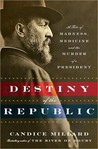
Review: Destiny of the Republic: A Tale of Madness, Medicine and the Murder of a President

Destiny of the Republic: A Tale of Madness, Medicine and the Murder of a President Destiny of the Republic: A Tale of Madness, Medicine and the Murder of a President by Candice Millard
My rating: 4 of 5 stars

This nineteenth-century, post-Civil-War story, like almost all stories, intertwines the lives of several people. Key characters include U.S. President James Garfield, Alexander Graham Bell, Garfield's assassin, Garfield's chief doctor/surgeon, Bell's wife and son, Garfield's wife, and Vice President Chester Arthur.

An assassin - clearly mentally ill, probably with bipolar disorder - shoots Garfield, but not fatally. His American doctors continually probe the wound with their unclean hands. They did so after Lister made and publicized his finding of the value of antisepsis, but before his reforms were widely adopted in America. The physicians were unable to find the bullet as they assumed it lay on the right side of Garfield's body, where the skin wound lay.

Bell invented a primitive metal detector to search for the bullet. He was unable to succeed, however, in Garfield's case because Garfield's doctors forbade him from searching on the left side of his body. Nonetheless, Bell's device was used to find bullets well into the twentieth century (when X-Rays became the gold standard).

The assassin, delusional that the country wanted Garfield dead, ended up trying the insanity defense and failing. He was eventually hung.

Garfield's autopsy showed the true location of the bullet and the real cause of death - bacterial infection (sepsis) of the blood. His body contained pus vacuoles all over, and pustules covered his skin.

Nonetheless, this magnanimous event united the Republic as both North and South expressed deep concern about the president's medical course and mourned the president's death. The newly christened President Arthur becomes the most dynamic character in this story. Previously held in suspicion as being cowardly and deferential towards the political machine, he resolves to lead the country as Garfield would. He reasoned that the people of the United States elected Garfield, not him, and they deserved that their will be borne out. Arthur became an effective one-term President who led meaningful (but not ambitious) reforms of the corrupt "Spoils" system that previously buoyed his career.

View all my reviews

Sunday, March 24, 2019

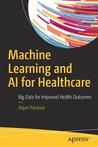
Review: Machine Learning and AI for Healthcare: Big Data for Improved Health Outcomes

Machine Learning and AI for Healthcare: Big Data for Improved Health Outcomes Machine Learning and AI for Healthcare: Big Data for Improved Health Outcomes by Arjun Panesar
My rating: 4 of 5 stars

After the first chapter of this book, I was ready to put it down and regret the money I spent on it. It seemed to walk over ground that I've already covered as a researcher in medical informatics. Fortunately, I continued, for I came to learn a lot from this author. Although not as succinctly written as academic papers, this book is thoroughly researched and comments on an emerging field - the intersection of healthcare and software. It also comments on this from a British perspective. I am used to reading Americans comment on this field, but comments from a Brit who possesses experience in the field is particularly interesting to me.

The author's experience in this field is particular to Type-2 Diabetes. It is quite obvious that his research tilts towards diabetes. I would like to hear more from this author about work that's being done on other major diseases like HIV/AIDS, malaria, emerging diseases, cystic fibrosis, etc. That is a tall order to ask, I understand, and much work needs to be done for this to be the case. Nonetheless, this is the broad frontier that we now face between medicine and computers.

I'm glad that Panesar added his voice to the effort to leverage computers to fight disease, and I'm glad that I took the time to listen.

View all my reviews

Saturday, March 23, 2019

Review: Team of Rivals: The Political Genius of Abraham Lincoln

Team of Rivals: The Political Genius of Abraham Lincoln Team of Rivals: The Political Genius of Abraham Lincoln by Doris Kearns Goodwin
My rating: 5 of 5 stars

This in-depth look into the lives of Lincoln and his closest advisors meets the hype. It tells the life histories of President Lincoln, his attorney general Bates, his treasury secretary Chase, and his secretary of state Seward. All four had a chance of being nominated as the Republican candidate in Chicago, but Lincoln secured the nod. In turn, he placed the other three in his cabinet.

Although their initial impression of Lincoln was that he was a mere "prairie lawyer," Lincoln soon surpassed their expectations. He earned their respect (even admiration) for his ability to lead the Union during the Civil War with "malice towards none and charity towards all."

Kearns-Goodwin's book has won the praise of Barack Obama, who used this book as a template in forming his Cabinet. Indeed, this book provides an excellent study on leadership, as Obama's support describes. Lincoln took a position of power, effected change, encountered and overcame difficulties, and won the respect of his fellows.

This 1000-page tome tells that tale to a new generation. It deserves to be placed near the front of a long line of Lincoln biographies - near Nicolay and Hay's 10-volume work and Sandburg's 4-volume take.

View all my reviews

Sunday, March 17, 2019

Review: Eat That Frog!: 21 Great Ways to Stop Procrastinating and Get More Done in Less Time

Eat That Frog!: 21 Great Ways to Stop Procrastinating and Get More Done in Less Time Eat That Frog!: 21 Great Ways to Stop Procrastinating and Get More Done in Less Time by Brian Tracy
My rating: 3 of 5 stars

This is a good, solid, well-written book on time management. Whether you are seeking to improve the management of your own time or empathize with others as they attempt to become better stewards of their own time, this book will say it all - in only 21 short chapters!

Its central premise, that time is best managed by taking the hardest project on first, is a reliable and well-tested one. From this premise (put into a metaphor by eating a frog first), the entire book flows.

As with any 100-to-150-page book, what it captures in its brevity, it leaves out in its depth. It does not dwell on these subjects for an extended outlay of pages. If that is what you want - a series of short "devotionals" on time management - this book is for you. If you want to dive into a topic in depth, this book is not for you; perhaps you should pick up something by Peter Drucker.

The third edition (which I read) contains two helpful chapters on the time management of email - of pertinence to our society today. I like Mr. Tracy's contributions to discussion on these topics and welcome his insights into my practice.

View all my reviews

Thursday, March 7, 2019

Review: Design Patterns: Elements of Reusable Object-Oriented Software

Design Patterns: Elements of Reusable Object-Oriented Software Design Patterns: Elements of Reusable Object-Oriented Software by Erich Gamma
My rating: 0 of 5 stars

A classic in the field of computer science, this book describes how object-oriented software can be used to develop meaningful (and reusable) classes. It is written by the so-called "gang of four" affiliated with a working group at the University of Illinois. It has achieved notoriety for its assistance in helping programmers write code more effectively in languages like C++, SmallTalk, and (my current language) PHP. The book has started a large movement in identifying design principles that are inherent in all computer science problems.

The book reads like a catalog of class types. After an initial critique on the state of computer programming, it reads like a textbook and a reference manual to be used. It is academic, analytical, and brilliant. Obviously, the book is only for the serious programmer who aspires to master her/his trade. It is not for the casual programmer or even for the intermediate programmer. It does not hold the reader's metaphorical hand as the book is perused. Instead, it provides data and analysis like a research paper. Of course, in such a style, wisdom is distilled into compact sentences.

I'll be happy to put this book on my bookshelf at work and refer to it when designing software.

View all my reviews

Review: How To Write a Simple Book Review: It's easier than you think

How To Write a Simple Book Review: It's easier than you think by Allyson R. Abbott My rating: 3 of 5 stars ...