Wednesday, February 27, 2019

Review: Narrative of the Life of Frederick Douglass

Narrative of the Life of Frederick Douglass Narrative of the Life of Frederick Douglass by Frederick Douglass
My rating: 0 of 5 stars

Obviously, this work belongs to history rather than to a shelf of recent releases. Nonetheless, it is clearly written, interesting, and provides much insight into the mind of nineteenth-century Americans in the North, in the South, and in slavery. I found Douglass's writing abundantly lucid and to the point.

It's interesting how American in many ways represented two societies at the time - one free, the other deeply tainted by slavery. The claim Douglass makes in this account 15 years before the Civil War is that slavery does not make humanity moral. It cheapens everything.

In the closing chapters, Douglass describes what freedom in the North was like. He suspected that there would be no rich people in the North because there was no slavery. The only rich people in the South were those with slaves; those without slaves in the South struggled to make ends meet. However, he found that the freedom of the North allowed human freedom to extend into more noble virtues. Life was simply better there.

One wonders if there are parallels to our much-divided politics today. But that would turn this book review into a political tome. So instead, I will merely say that freedom begets freedom, whether in antebellum America or in a globalized village. I think Douglass's account can take us thus far.

View all my reviews

Saturday, February 23, 2019

Review: Mythology: Timeless Tales of Gods and Heroes

Mythology: Timeless Tales of Gods and Heroes Mythology: Timeless Tales of Gods and Heroes by Edith Hamilton
My rating: 0 of 5 stars

This book, widely recognized as a classic - or perhaps the classic - in the field of mythology, provides not just Hamilton's scholarship over a lifetime of classical myths; it provides Hamilton's outlay for how to live the good life. She respects and admires the Greek and Roman cultures whose myths she portrays - so much so that she attempts to convince the reader of their nobility and ability to transform contemporary life.

Mythology in an age of science has its own issues. Nonetheless, we as a culture have certain archetypal stories that we share so as to maintain social cohesion from neighbor-to-neighbor. Phrases like "the girl next door," "listen to the siren-song," or "a Trojan horse" all harken to prior stories in our cultural memory. Some of these go as far back as Greco-Roman mythology. Hamilton brings these allusions to life and remind us of our cultural debt to those who lived thousands of years ago.

It's amazing to think of how much we owe, particularly to the Greeks as intellectual originators and less so to the Romans as cultural progenitors. How did this small island people bring about such enlightenment that students still study their materials in modern America today (e.g., Euclid's Geometry)? Why Greece, of all places? Mythology does not answer all these questions. Instead, it brings us along the way as it tells a story of civilization, of humanity, and of ourselves.

View all my reviews

Sunday, February 10, 2019

Review: Mastering Deep Learning: A Complete Introduction for Beginners and Newbies

Mastering Deep Learning: A Complete Introduction for Beginners and Newbies Mastering Deep Learning: A Complete Introduction for Beginners and Newbies by James Gabriel
My rating: 0 of 5 stars

Deep Learning seeks to mimic how humans learn (i.e., the brain processes of how humans learn in their cerebral cortex) and apply this mimicry to how computer programs are written. Thus, we have terms like a "neural network" which does not refer to a brain (made up of neurons) but to a web of computer cells which "learn" how to produce certain output from input data.

One interesting application of such is detailed in the book. A Generator attempts to produce a fake image, and a Discriminator attempts to figure out which items are fakes. When paired together with machine learning, they can produce a fairly good fake image.

What's somewhat scary about this technology is seen in the newspapers and social networks of today. "Fake news" is not merely news which is contrary to a certain viewpoint; fake news can be a video clip of some famous person saying some phrase that she never uttered! If that doesn't sound like 1984 (or 2016?), I don't know what does.

View all my reviews

Saturday, February 9, 2019

How to Read Literature Like a Professor: A Lively and Entertaining Guide to Reading Between the Lines

by Thomas C Foster
Copyright (c) 2014

I found this book while on a search for a good introduction to literary criticism. This seemed to hit the mark. In it, Foster pursues hard-core analysis of the literary project while spinning a down-to-earth persona (which was obviously well-honed while in a classroom). I was not let down.

One can see why Foster's work is popular among Advanced Placement English teachers in America. He presents himself as one of us (i.e., American and not British), only with a deep erudition of literature. He invites us to see literature symbolically with the emotional weight of the literary tradition on our backs. We begin to see everyday literature as an intertextual conversation amongst the ages, where writers borrow ideas from each other and analyze each other's tomes.

Foster tackles topics like the weather, sex, irony, journeys and quests, and more. As the subtitle tells us, he teaches us to read between the lines as professors do. I hope that reading between the lines will lead to a greater efficacy of writing so that others can read between the lines as well.

Underlying this book is Foster's theory that increasing literary appreciation will lead to greater enjoyment of books. I suspect that he is right on.

Tuesday, February 5, 2019

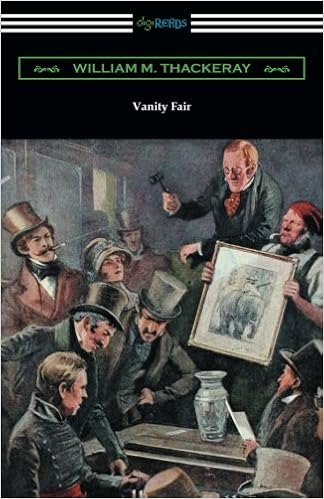
Vanity Fair: A Novel Without a Hero

by William M. Thackeray
Written 1847-1848

This novel, set in part around the famed Battle of Waterloo in which Napoleon gets his ultimate defeat at the hands of the British, goes through 66 chapters of set up for a tumultuous (and brilliant) final chapter in which every supposition in the prior chapters is set on its head. As a whole, this book is witty, wonderful, and enchanting. It is fit to be a classic - indeed, one of the best books I've ever read.

It is set around the main character, born Becky Sharp. She is a social climber who built her life up from poverty. However, as the subtitle of this book intones, she is an ignoble protagonist. She stirs her hand in every section of the book as a manipulator and as a fraud, yet somehow much good is wrought by her improprieties in the lives of many of her compatriots.

This book provides an interesting look into the lives of England in the 1800s. English classism and the pettiness of nobles are on full display. Nonetheless, there are noble, though still flawed and human, characters such as Amelia. The story traverses from character to character as a masterful plot is wrought.

I especially enjoyed Thackeray's wit - on full display in various comments on the narrative. He writes like a journalist, but not one striving for poor objectivity as is seen in the American practice. He entertains as he tells - and is shown to be a master of the quill.

Review: How To Write a Simple Book Review: It's easier than you think

How To Write a Simple Book Review: It's easier than you think by Allyson R. Abbott My rating: 3 of 5 stars ...