Thursday, November 29, 2018

The Mythical Man-Month: Essays on Software Engineering

by Frederick P. Brooks
Copyright (c) 1995

What is relevant about a book, in its second edition, that was originally written a generation or two ago about managing computer projects? The author Brooks led the management of the project for IBM decades ago.

The answer to this question is simple and is evident in the title. Scaling software projects from smaller-to-larger does not scale linearly. In case you don't know what this means, scaling non-linearly means that a project twice as big does not require twice as many "man-months." It more likely requires four times as many "man-months" because of the need for communication among programmers.

Brooks shows the aged wisdom of the idea that computer programming is indeed part communication and not fully mathematical problem solving. Brooks then tries to figure out how to manage projects that are larger and that require more communication. Many of the references are aged and not for those who don't appreciate the history of computation. Nonetheless, for those who like to dabble in history, Brooks' take - always bright - makes us see that the problem of successfully managing software projects is not a new one. Indeed, there are timeless values which undergird technical success.

This anniversary edition includes a retrospective account that evaluates many of the propositions originally put forth decades ago. (Brooks was mostly right, we see.) However, I wish Brooks would also lend some ink - in the light of the additional experience of a couple of decades - to the questions of what makes a software project successful in the first place. Merely being right should fade while understanding timeless values should come to the fore.


Monday, November 26, 2018

The Life of Thomas More

by Peter Ackroyd
Copyright (c) 1998

Thomas More is one of the few beatified English lay-persons in history. He was beheaded for resisting the coming Protestant Reformation. What comes around, goes around, however; More, in the years before King Henry's divorce of Catherine of Aragon, oversaw the exercise of the death penalty to several Protestant heretics. He stood, as Ackroyd tells it, for the old way of medieval Christendom. He was unwilling to accommodate the Reformers' ways of change in England. He refused to take an oath of conformity that King Henry was the Head of the Church in England and did not speak about the King's divorce. His silence spoke louder than any words and led to his untimely death.

Of course, he famously remained silent on Henry's second marriage and paid the price for it. He saw the old ways of Natural Law and reason as the true ways and was not afraid of dying for it. One wonders what More would say about the coming bloody purges in English Christianity, with Bloody Mary, Fox's Book of Martyrs, and Queen Elizabeth.

An American reader cannot help but note the contrast between European Christianity and American Christianity. European Christianity is tied inexorably to the state whereas American Christianity, formed in the incubator of the separation of Church and state, is more of a creative and progressive force in American history - at least until the resurgence of the fundamentalists in the second half of the twentieth century. Reading a biography like More's induces a longing for atheism and freedom from religion - despite the fact that religious piety animated this man's silence towards Henry.

One can only wonder if American Christianity is capable of producing a Thomas More given our predilections against the intermixing of church and state. In no small thanks to More, conscientious objectors no longer face death penalties (although alternate service could still be debilitating). Such character would stand out in any nation's history. Natural Law and reason are popular in present-day conservative circles, especially among intellectuals, but popular conservatism seems antithetical to More-like principle-driven action. More stood for a passing medieval order; for that, he deserves our pity. But for the fact that he still stood tall and silent until his guilty sentence, he deserves our sympathetic admiration.

Resources to Explore: History

The Historiography of Contemporary Science, Technology, and Medicine edited by Ronald E. Doel and Thomas Soderqvist

Technology in America: A History of Individuals and Ideas edited by Carroll Pursell and Merritt Roe Smith

Thursday, November 22, 2018

Refactoring: Improving the Design of Existing Code

by Martin Folwer
Copyright (c) 1999

I picked up this book at the wrong time. The book was so successful that a second edition is due out on November 30, 2018 (less than two weeks from now).

On the other hand, I picked up this book at the right time. At work, my project is in the midst of a refactoring project. I am in the middle of changing PHP code from modular functions to object-orientation. The aim of this transition is to enhance the scalability of the project and ease the writing of documentation. I generally like to peer "beneath the surface" of skills that I acquire; this book has indeed enlightened my mind to details of what is going on in my code rewrite.

Some of this book is incredibly tedious. It details how to change code from one format to another. It's work that I let my fingers do more of - and my brain less of! But the book also frames how to do this work and why it is so important. It ties together intellectual "loose ends" which might not be tied together by the programmer who simply dives "head first" into the project.

Fowler writes in tandem with a research seminar at the University of Illinois who have pioneered object-oriented techniques in Smalltalk and then Java and C++. They tackle the concepts of refactoring more than how to tackle the specifics of coding in a language. I prefer their theoretical approach to more common approaches drenched in technical lingo and programming tools. This book was worth its time.

Einstein: His Life and Universe

by Walter Isaacson
Copyright (c) 2007.

This book, based upon recent public releases of Einstein's private letters, provides a more intimate portrait of Einstein than has been possible before recent years. Einstein's prowess as an intellectual and a scholar is well-known. His closest relationships - with his sons, both of his wives, and his daughters - has not been well-known.

What do we discover from this in-depth look at the man who helped set the course of the twentieth century? We see a man engrossed in his studies of physics; we see a man who cared deeply about the people around him; we see a man who is sometimes aloof to interpersonal affects as well as to geopolitics; we see a man who is warm yet deeply wedded to his theoretical physics work; we see a man thoroughly defeated when it came to quantum mechanics; we see a man who is, in many respects, like all of us.

This man of 112 Mercer Street in Princeton taught the world the rules of the universe. Then he taught the world more deeply by his manner. He fought for what he thought was right to the end and stubbornly refused to admit defeat in the realm of world government or the nature of reality. This portrait provides us with intimate access to a genius - intimate access that, until 2007, was simply not possible. For that alone (besides being a well-written account from one of our best English-language historians), it deserves our attention.

Friday, November 16, 2018

Resources to Explore: Software


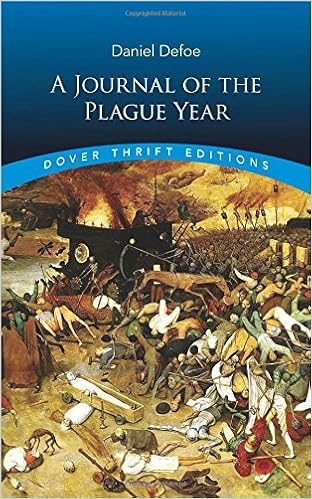
A Journal of the Plague Year

by Daniel Defoe
Written 1722

The years 1665-1666 were rough for London. 1665 brought plague, and 1666 brought a city-wide fire. This book contains a fictionalized account of that plague year of 1665. Defoe, writing 50+ years hence, constructed a narrative based upon research in journals from that era. In providing an account of these interesting times, this book provides several interesting interludes. Like the story of a naked Quaker who walked the streets. Or how the poor and city officers bravely attacked the disease to make the city function.

It is always interesting to study British history through the lens of class. Ironically, the clergy and the well-to-do did not confront the illness with as much braveness as the lower classes. Although the poor suffered most from the disease (think of the close living quarters in pre-Industrial-Revolution London), they were less paralyzed by fear of the "distemper." Remember that people at that time did not know that the plague was caused by rats. They just knew that it was a "contagion" that was transmitted in an area. For all they knew, it was an act of God's displeasure upon London, not a relatively random event in the history of bacteria!

Fear, courage, and madness are all on display in this dystopian tale. One cannot help but wonder how modern London would respond to a similar crisis. We have record of an Ebola outbreak in recent years in Africa to compare to. That public health crisis was not handled too well by the international community. Fortunately, London now has a public health system that can respond to emergent outbreaks with speed and skill. Perhaps that prevention is the lesson of the plague year for us. We do not suffer these kind of events commonly because we attend to their prevention in the early stages of problems. What of our problems will those 300 years from now read and wonder about in the pages of our literature? One can only dream...

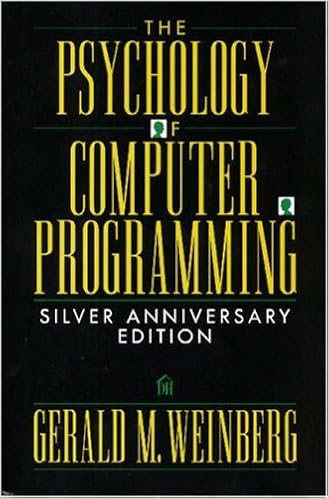
The Psychology of Computer Programming: Silver Anniversary Edition

by Gerald M. Weinberg
Copyright (c) 1998, 1971

This book is misnamed, as the author admits. It should be named "The Anthropology of Computer Programming." It studies the culture of computer programming rather than the psychology of the practice. Fortunately, despite being written over forty years ago, it succeeds at its task for the reader today as well as for the original reader.

If you can move past the references to dated languages and programming practices, this book elucidates many observations about how programmers work. It's like reading an anthropology of a long-hidden culture from decades ago. From one who works in computer programming, the cultural fruit of these observations can be seen in labs today.

To be frank, I've never felt that I've truly understood my peers in the lab. I've done well with the computer - with expressing myself through programs. So many of my peers are socially passive in their demeanor. I'm outgoing, even energetic. The cultural analysis in this book, though dated, helps me see this culture more clearly. It helps me feel more at home in my own environment - and perhaps also, in my own skin. As such, this book achieved its goal in my life, and for that, I am sincerely grateful.

Sunday, November 4, 2018

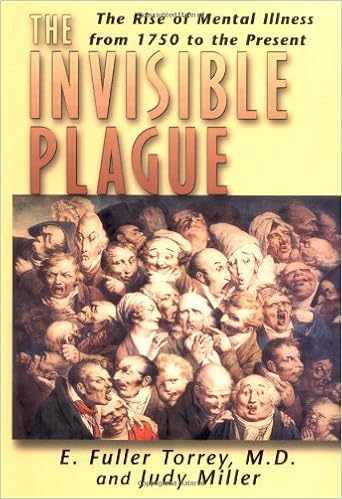
The Invisible Plague: The Rise of Mental Illness from 1750 to the Present

by E. Fuller Torrey and Judy Miller
(c) Copyright 2002.

This book, written in part by a psychiatrist with expert knowledge of schizophrenia, addresses the question of why mental illness has become increasingly pervasive since 1750. Starting with this date and proceeding towards the present, Torrey and Miller make a commanding case that the prevalence of mental illness has increased steadily since the age of Enlightenment, at least in English-speaking countries. The argument is forceful.

They argue against the common argument - pushed forward by many in prominence like Michel Foucault - that the diagnosis of insanity/psychosis is merely a way of pushing away societal nonconformists into asylums. The finding of MRI changes in those with bipolar disorder or schizophrenia, for one, argues for some kind of biology of disease, not merely a sociology. Further, the contention that genetics provides a key does not answer the question: What in modernity has led to the spread of mental diseases? Why did we not see this prior to 1750?
The authors propose a wide variety of possible (but unconfirmed) causes, all centered around the hypothesis that urbanization plays a key role. This case is well-argued and deserves attention and research.

Resources to Explore: Healthcare, Children's


Robinson Crusoe by Daniel Defoe

Saturday, November 3, 2018

Information Dashboard Design: Displaying data for at-a-glance monitoring

by Stephen Few
(c) Copyright 2013.

Dashboards are a hot topic in our information-laden world. They are imagined by those in the design world (often very poorly) and implemented by programmers who do not take their imagination any further. This book, written by an acknowledged expert in the field of visualization, describes how to design dashboards that communicate essential data to users, mostly business-people. As such, its audience consists of designers, not programmers. Although I am a programmer, I enjoy "cross-training" my imagination by thinking in the intellectual "boxes" or "bins" of those around me.

Few introduces standard graphs and a couple new ones (bullet graphs and sparklines). He explains the use of each in standard fashion. His real contribution, after explaining the fairly standard song-and-dance, is through the introduction of these new graphs, one of which he invented. I was curious to try to implement these two graphs using R's ggplot. Although I have no immediate use for these types of graphs, it's nice to have new tools in the box of memory to explain people's data accurately and effectively.

The Good Neighbor: The Life and Work of Fred Rogers

by Maxwell King
Audiobook

Fred Rogers, a.k.a. Mr Rogers, grew up the son of a rich businessman, majored in music at college, got into television in the early years of NBC, studied at seminary to become a Presbyterian minister, started children's television at the Canadian Broadcasting Corporation in Toronto, and extended children's television into education with PBS. He is fondly remembered as being extraordinarily patient with children just by being himself. A generation of children - ok, maybe several generations of children - spend some of their earliest years being taught by this man about emotional intelligence and social formation. His work continues on to this day through the cartoon Daniel Tiger.

This book skillfully tells the story of his life, beginning as a sensitive young boy until his life as a retired king of broadcasting. It explains the quirks of his personality at every turn. It pays particular homage to his intellectual formation as a musician and as a seminarian studying child development under Dr. McFarland. Rogers incorporated facets from all parts of his life into his work and show. That is how he shared his creative genius with the world.

For those who have already been touched by the life and work of Fred Rogers, this book will bring back memories of learning under this influential man. For those who are not familiar with him, it will educate you on how a life - a male life, nonetheless - can be so fully dedicated to the well-being of children. Rogers thought it immoral to manipulate an innocent child through commercials and did not fully capitalize on his work. (Of course, he was born independently wealthy.) His idealism and kind goodness is well transmitted to the reader - or the listener - through this book.

Review: How To Write a Simple Book Review: It's easier than you think

How To Write a Simple Book Review: It's easier than you think by Allyson R. Abbott My rating: 3 of 5 stars ...