Monday, September 24, 2018

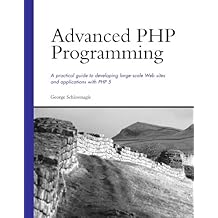
Advanced PHP Programming: A practical guide to developing large-scale Web sites and applications with PHP 5

by George Scholassnagle
(c) Copyright 2004

This book applies both to PHP 5 and PHP 7 (no PHP 6 exists) fairly well because of the large amount of overlap between the versions. This book is meant to build up experts at PHP development. It handles everything ranging from cookies, to APIs, to extending PHP via C. At 650-pages, it's a heavy read. There are lots of code examples as well as implementations of features (e.g., user authentication).

There is little that is cutting-edge in this book. It covers technology that still is useful but has been out for a while (hence the 2004 copyright). It falls short of being a classic. Nonetheless, the skills contained in this book are still useful to contemporary PHP development that continues to this day.

In particular, I found the benchmarking section helpful to my own PHP development. Schlossnagle taught me how I can track how much CPU time particular pages are using in my applications. This may not be useful for low-level websites, but it is helpful for larger applications that do some computation or database calls as a part of their feature set.

This book also has helpful texts suggested for further reading. Mainly books, not papers, are cited in these references. As a compulsive bibliophile, I like picking up on references to read further down the road.


Ry's Git Tutorial

by Ryan Hodson
eBook (free)

This book is a free purchase from Amazon. (You can't beat that price!) It previews the Git utilities now popular in the field of revision/change management software. It can keep track of your old files in a programming project and coordinate among multiple developers (therein facilitating distributed development).

I use Git at work. I've seen teammates more advanced at Git interrogate a Git database to extract useful information, restore backups, and generally make software project management easier.

The bulk of this book provides examples of using Git to track projects. It has a chapter on Tricks to share how to make Git more efficient for your use.  It also provides a brief tutorial on Plumbing (how Git organizes its internal database). This will enable you to do advanced work in tracking projects.

All-in-all, for a free resource, this book is a fairly helpful introduction to Git.

Tuesday, September 18, 2018

Spitting Blood: The History of Tuberculosis

by Helen Bynum
(c) Copyright 2012, 2015.

This book, part of Oxford University Press's series on "biographies" of diseases, highlights one disease the haunted humankind for millennia - tuberculosis/consumption. This battle, like its infectious disease brethren of malaria and yellow fever, is as old as recorded civilization. Like most infectious diseases, it has become a victim of its success in that its prevalence is now only among some of the "less desirables" of humanity: The developing world, the homeless, those with HIV/AIDS, and displaced persons.

As with malaria, one can wonder whether tuberculosis (in its MDRTB form - multi-drug resistant tuberculosis) might make a "comeback" someday in the form of a epidemic in the West. All that it would take is a little lackadaisical behavior on the part of a few public health centers in urban environments. Educational works like Bynum's help combat such human tendencies by keeping us aware of these challenges.

Current therapy involves direct observation of ingestion of four medicines which have significant side effects. Communities like immigrants, who face the double whammy of coming from countries with endemic TB and of living in crowded environments which are conducive to TB, can benefit from a dose of preventative medicine in being coached how to be sanitary when living in close quarters.

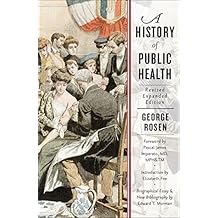
A History of Public Health

by George Rosen
(c) Copyright 1958, 1993, 2015.

George Rosen wrote this book, originally published in 1958, about the progress that humanity has made in this field. He was optimistic about the progress made with antibiotics and vaccines. He saw opportunity for the eradication of smallpox and malaria. He saw the trajectory of human progress as going upwards.

In 2018, this optimism has been somewhat muted by the realities of HIV/AIDS, by the lingering persistence of many infectious diseases, by the advent of antibiotic-resistant organisms, and by populist movements like the anti-vaccinators. The second half of the twentieth century brought a huge dose of reality to the field of public health.

The updated prologues to this book testify to these historical events. Nonetheless, Rosen's work provides a great template and introduction to the field of public health. From its early beginnings in Egypt, Greece, Rome, and other centers of civilization in the ancient world, public health campaigns have bettered the lives of billions.

I found it especially interesting to survey the different attitudes towards public health and nationalized medicine in various countries. For example, Germany has viewed healthcare with a nationalistic lens dating back to the nineteenth century and the advent of German nationalism. The United States, however, has long been suspicious of such an organizational plan and has suffered inefficiencies due to its paranoia. Cuba has excellent healthcare efficiency. The UK, originally split along political lines about nationalized healthcare, has since viewed its National Health Service with a great deal of national pride. Perhaps there is hope for the United States to resolve its internal squabbles after all.

Sunday, September 9, 2018

Resources to Explore: Health Care


Infections and Inequalities: The Modern Plagues

by Paul Farmer
Copyright (c) 2001.

Paul Farmer is a genius and is worthy of reading by anyone interested in his field of medical anthropology. An MD/PhD professor of Harvard and founder of Partners in Health, Farmer, perhaps better than anyone else alive, embodies the ethic that health care is a human right.

In this book, he writes on his experiences in Haiti. He writes of fighting AIDS and Tuberculosis. He points out that poverty is not only correlated with these diseases but is perhaps a cause. By his broad training, he spans two schools of thought about how to fight these diseases. Poverty must be fought, but so too must the diseases. That is, the diseases synergistically amplify the poverty, and poverty, in turn, amplifies the diseases.

Unfortunately, AIDS (sida in Haiti's Creole language) and TB form a synergy amongst each other that haunts the public health of this island-nation. Farmer's work is laudable as always, and the needless expense of human capital in Haiti at the hands of disease and poverty - yes, infections and inequalities - is an immense tragedy. One wonders how Haiti can prosper. Certainly more Paul Farmers would help.

Review: How To Write a Simple Book Review: It's easier than you think

How To Write a Simple Book Review: It's easier than you think by Allyson R. Abbott My rating: 3 of 5 stars ...