Saturday, July 28, 2018

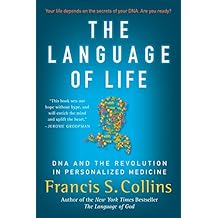
The Language of Life: DNA and the Revolution in Personalized Medicine

by Francis S. Collins
(c) 2010

 My employer (Vanderbilt University Medical Center) is the world's leader in implementing the ideas around personalized medicine, so I picked up this audiobook to educate me on what's going on around me while I drove to and from work. In it, I found interesting stories from patients combined with weighty data from the human genome.

Collins maintains a warm bedside manner as well as a writer as he does as a researcher, NIH leader, and physician. His homespun manner makes his writing relatable and engaging. It is obvious that he cares about patients as the center of all his work - a nice trait for a driven, big-time researcher to have.

The science described in this book continued trends I sensed while I was a medical student. The question of who-has-what-genes will likely guide science for the better part of my life. Collins engages these questions with the latest (as of the time of his writing) science has to offer. Genetics is indeed a fun field to follow.

Genetics opens up a whole host of research and ethical questions that is currently engaging us as a society. Is gene therapy (which surely is coming) ethical? To what extent do genomics play God? And to what extent are our genes reflections on our experience as much as our heredity? Is religion going to play the role of being merely against technology or will it sublimate itself to aid healing? What will the medical clinic look like in 2050? Also, what will the birth process (and the electronic medical record) look like in 2050?

Collins' book is a good primer to these issues. Listening to it has been a joy for the past couple of weeks.

R for Data Science: Visualize, Model, Transform, Tidy, and Import Data

R for Data Science
by Hadley Wickham and Garret Grolemund.
(c) 2017.

If the above quote is the mission of this book, consider the task accomplished. Where most books in computer science fall down in trying to be cute while communicating an educational message, this book addresses the task of education about R squarely, and it does so in a manner that engages the mind with interesting problems.

Usually, I skip the exercises sections of most computer books because, well, they offer challenges that are underwhelming. Recall is all that is required to answer them. Usually, I can figure them out in the confines of my mind so that I don't have to waste my time looking up the answers or coding example code to check whether I'm right or where I err.

Not so for Hadley Wickham. Many of his questions were awakened my curiosity and had me applying me new knowledge in R Studio immediately. In fact, the only way I could answer my burning curiosity was to write code in order to test my hypotheses.

Rare is the computer book that is a page turner. This book qualifies as just that if one has the aptitude in statistics to embrace the challenges. R is an ideal language to handles these challenges in statistics, and Wickham and Grodemund fill the role of ideal apostles/evangelists to share this free fruit.

The fun part about R is that it is free, creative, and well-supplied with packages to solve interesting statistical problems. This book carries that message squarely to my lap (and then to my brain) in an engaging manner.

Wednesday, July 18, 2018

Translational Research and Clinical Practice: Basic Tools for Medical Decision Making and Self-Learning

by Stephen C. Aronoff.
(c) 2011.

This book was a review - and to some degree, an extension - of medical school for me. I always enjoyed reviewing the medical literature. In fact, it was my favorite part of my medical training and the part I miss the most. I love translating research into clinical advice.

Unfortunately, fortune had it that the clinic was not to be my domain, so I sit in the research realm now. I am helping others produce research that translates research into clinically relevant information. Or perhaps more succinctly, I have become a lab rat. I spend my weekends learning esoteric computer languages with the hope of making a small dent in the realm of biomedical research.

I picked up this book because it used the term "Translational Research" in the title. When my colleagues use the term "Translational Research," they mean research that helps the bench-to-bedside transition, generally starting at the bench. We are pushing research out efficiently to be consumed. Aronoff does not mean this. Instead, he is gazing from the clinic and pulling research through translation to patients. His view of self-education is the way to do it. Self-education essentially consists of reflecting on patients through controlled searches in the medical literature. That is the goal of evidence-based medicine, and Aronoff seems to have mastered its presentation.

He suggests only a little time (around 20% of total self-education time) being spent reading seminal journals or garnering CME credits. 80% of a physician's self-education time should be spent in pericopes on patient experiences. This will enable her to converse more openly and reason more completely with patients.

Interestingly, Aronoff suggests that a physician not read the discussion on the papers as that is wasted time. Instead, systematically interrogate papers through questions about clinical relevance. That, in essence, is his method.

This deep-dive into the clinical domain of the relevance of translational research has been enjoyable. One can spend their whole career doing the concepts taught in this book and using it as a lens to explore the world through. It's a privilege to study methodology that others use routinely.

Sunday, July 15, 2018

Data Points: Visualization That Means Something

by Nathan Yau.
(c) 2013

Data Points reads like a friendly textbook engaged with visualization. It is less concerned with tips and tricks, and more concerned with understanding. For instance, on the neverending debate on pie charts, Yau pleads neutrality. He sees that pie charts have
their place, albeit a limited one, in the visualization domain. As such, he promotes freedom and the ability to choose above all.

There are lots of data that need appropriate visualization in today's world. The ability to procure data on just about anything has gone up astronomically in recent years. Yau's approach does not offer a lot towards programmers who want to mass-produce visualizations. Instead, this author of FolowingData.com focuses on building one powerful, elegant visualization at a time. He's less an artist and more a statistician (belying his PhD in Statistics). He focuses on communicating the right message through visualization of your data.

As is customary in books like this, the examples tend to carry the narrative. While the communication of the principles of visualization is the primary message of this book, Yau carries his story through interesting examples of how people communicate (and sometimes miscommunicate) with data. While not as erudite and varied as Tufte's compilations, Yau's work provides much food for thought as the reader analyzes the graphics. Reading this book is simply fun.

Tuesday, July 10, 2018

Storytelling with Data: A Data Visualization Guide for Business Professionals

by Cole Nussbaumer Knaflic
(c) 2015

Back in my first programming job after college, I was dabbling in graphics for some bit of computer code that analyzed genetic data. I read some works by Edward Tufte, an expert from Yale who made academic munch-meat of visualization data for his career. The verbiage was lofty; the images were inspiring; and I could not figure out how to translate the lofty rhetoric and aesthetics into meaningful graphics and meaningful insight.

Twenty years later, enter Cole Nussbaumer Knaflic. Cole translated the practicalities of how to handle Microsoft Excel and a dataset into meaningful visualizations. I spend a significant portion of my time at work trying to generate graphics that will mean something to someone somewhere (read for an undisclosed audience), and I would benefit from understanding how visualizations work better.

From Cole, I learned how to translate anything into a bar chart, how to simplify a series of numbers into something that will communicate quickly and effectively, and how never to use a pie chart or a donut chart to clog visual communication. This work fills the gap between more academic works (such as Tufte's, inspiring but lofty) and the practicalities of doing everyday graphics on a budget.

Most interesting are the resources used in this work. The text references many books and blogs that can be consulted for further insight. (Confession: I have already bought two of these books, checked-out one from the library, and bookmarked eleven blogs.) The literature review has proved to make this book worth it in and of itself.

Simple tricks (like adjusting the alignment of the headers for axes to left or right instead of center) that enhance readability also make this book worth its weight in gold bar-charts. If you have a friend who is an artist and have a budget to pay her well, seek after Tufte's work for inspiration. But if you want to garner the technical know-how to transform some data points into something meaningful, elegant, and effective, I suggest this work for you.

Saturday, July 7, 2018

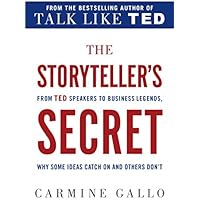
The Storyteller's Secret: From TED Speakers to Business Leaders, Why Some Ideas Catch on and Others Don't

by Carmine Gallo
(c) 2016.

Having spent five years in medical school, I tend to see the world through data - through facts and figures and not stories. My reading this book proves that I am still interested in the power of stories. Gallo uncorks the power of a narrative through a bunch of stories (some religious, some business-oriented, some humanitarian, all moving).

Each chapter provides a report of one person's life experiences. Skillfully, Gallo starts the report with the person's first name - a move that provides a degree of anonymity for a well-known figure - and the naked tale with an eye towards a lesson. Then an analysis follows with a more philosophical and rhetorical parsing of the event. Finally, the lesson is summed up in one paragraph - a "secret" of the storyteller. Repeat this about 37 times, and you have a 250-page book that provides easy, interesting reading and the honing of a skill.

Almost every human will know some of the people biographied in this book. Almost no one will know them all. Stories from figures such as Steve Jobs, Al Gore, Pope Francis, and Sheryl Sandberg are combined with those from lesser-known figures such as Steve Wynn, Chris Hadfield, Kat Cole, and Amy Purdy to provide a nicely interlaced metanarrative. This metanarrative dishes up the thesis that behind every great or moving happening is a great story - and thus, a great storyteller. That point is quite well proven in this book. The everyday is mixed up with the mighty, with recurring spectacular results.

I aspire to tell stories more effectively. Although I doubt I will ever reach Churchill's level of impact or excitement, I can work on my family, friends, and co-workers more effectively. This book equips me to do that better, and I am fortunate to have read it. I often focus on the philosophical side of life, but this book brings out the (often lost) art of rhetoric. Ideas without communication are indeed worthless.

Review: How To Write a Simple Book Review: It's easier than you think

How To Write a Simple Book Review: It's easier than you think by Allyson R. Abbott My rating: 3 of 5 stars ...