Saturday, June 23, 2018

TED Talks: The Official TED Guide to Public Speaking

The Official TED Guide to Public Speaking
by Chris Anderson

I grew up paying attention to my school teachers and to Southern Baptist preachers. There was a gap in what I heard. I heard lots of reason-based presentations at school. I learned in detail how the world worked (nature and humanity). I learned to think, to question, and to present myself as a reasonable human being.

However, at church, I learned something different. I learned the art of rhetoric. While at school, I learned how to evaluate an argument, at church, I learned how to make an argument. To present myself in a manner that worked with normal people. School taught me the dignified way of presentation; church taught me the effective way of presentation.

I hate to say it, but there's a difference. My schooling did not teach me leadership - to be effective. It did teach me efficiency - something my church pastors could have learned.

Fortunately, the TED program (as described in this book) is both effective and efficient in its aims. In it, I reminded myself of public-speaking principles for effective presentations. I learned about new, innovative ways of connecting with my audiences.

Most importantly, I learned ways that people are excited about transforming the world through thoughtful presentations. Example after example were drawn from real TED Talks about how to present effectively and efficiently. I was inspired over and over again while I honed my public speaking skills.

As the old saying goes, the world will marvel as you do common things in an uncommon way. This book definitely achieved that. Public speaking was refreshed as leadership in communication was inspired. Good rhetoric was taught. I recommend it to anyone who seeks to connect better with their fellow humans.

Tuesday, June 19, 2018

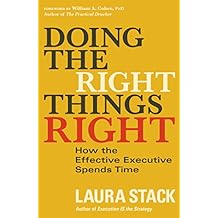
Doing the Right Things Right

by Laura Slack
Audiobook


This book's title borrows from Peter Drucker's famous distinction that management is doing things right and leadership is doing the right things. In the introduction, Slack says that she aspires to update Drucker's work on the executive worker for the Internet age. She does just that, incorporating advice for new situations throughout her work while remaining true to Drucker's principles.

That being said, she is no Drucker. Drucker's strength is focusing on the concepts in management. Most managers write management books as a bunch of tips. Drucker instead focuses on how to think as a manager. This is likely because Drucker never worked as a manager himself. He just coached managers in founding the field of management. He is the ultimate psychologist of management.

It's a high task to ask Slack to fill Drucker's shoes. In so doing, she reverts back to the "tips" style of writing, focusing on how to manage situations instead of how to think as a manager. She is compatible with Drucker's way of thinking, no doubt. And for this, she deserves a B or a B-minus. But somewhere along the way, she began to focus on situations more than thought.

I find reading books like hers nonetheless helpful check-ups on carrying myself at work. Management is more than being a manager. It is comporting one's self in a professional manner. It is managing one's own affairs rightly. It is prioritizing. It is making good judgments about resource allocation and conflict resolution.

Slack's book indeed touches on all of these areas and does an above-average job in each. She thinks through how email impacts time management and how the Information Superhighway impacts Drucker's concept of the knowledge worker well. (Doing email in bursts and segmenting time away from email helps productivity; the Internet discourages worker loyalty.)

I'm going to queue in my On Deck section Drucker's The Effective Executive, on which this book was patterned. I suspect Drucker will outclass Slack significantly in the ways described. Perhaps if I could find this book on audiobook, I would just read more of my favorite on management: Peter Drucker.

Saturday, June 16, 2018

Isaac Newton

by James Gleick
Copyright 2003

Sir Isaac Newton ranks among history's greatest geniuses. For inventing modern physics. For overturning Aristotle's hegemony upon thought. For co-inventing calculus (as an introduction to physics). For being more into theology and alchemy than physics.

His treasure-trove of personal writings - kept hidden until near the middle of the twentieth century - show this man to be, like Luther before him, the last of the great medievalists who birthed the movement of modernity. With Newton came the Industrial Revolution and a rigid system that Einsteinianism had to loosen. He obsessed over thought after thought, most based on alchemy and Arian/Gnostic theology (not orthodox Trinitarianism), until modern physics was birthed, and with it a deductive mechanism from first "principles."

He was born the son of an illiterate father whom he never knew. He seemed destined to become a farmer, but instead, privately reckoned physics into being at Cambridge. He never married. He was haunted by lust. He became rich by overseeing the conversion of Britain's Mint. He left no will, was close to none, was a recluse, and wrote brilliantly.

He was a magician, an alchemist, and a heretical theologian. He dabbled in unreason to give birth to reason. He later became an authoritarian over scientific thought. He feuded with Leibnitz, a feud which in some senses persists to this day. (They both are right in their claims, and humanity is the big loser of the argument. They should be seen as independent co-founders of calculus.)

His Principia removed Aristotle's impulsivity and set gravity as the central cause of all of motion. He derived calculus to explain its movement in a universal language. He made mathematics the foundational language of humanity.

It wasn't until Einstein that science returned to solving problems as its fundamental method. Even Darwin proposed a universal system, not a solution. With Einstein, relativity (which was the popular version of the physical laws Einstein proposed, much as mechanism was the popular import of Newtonianism) became in imbibed by Western consciousness. Now, scientists see things through a team spirit relative to one's position in work. Few claim to be systemic masters any longer, as if there were a system to master in the first place.

The rigid system of Newtonianism stays with us on the outskirts. Every time someone exerts a will to claim overarching knowledge (which is, in Newton's world, power), they claim Newton's authoritarian dark side. Trump, old-school Calvinism, old-school capitalism, moralism. There is right and wrong for Newton. Again, it took an Einstein to relativize everything.

I think the real Isaac Newton would have liked to know that sage of Princeton Albert Einstein. It's unfortunate that I also dream that Newton would have found much reason to argue with him, much as Newton privately argued with Leibnitz in his own day and Einstein argued with Quantum Mechanics for the second-half of his life. At least Newton was private in his argumentation. He preferred not to argue publicly. That's a character trait we can all learn from, especially in a post-Newtonian, post-Einsteinian world.

Tuesday, June 12, 2018

Galileo

by Bertolt Brecht
Copyright 1966

This book, as the introduction delineates, was originally written in Fascist Germany whose attitude towards science and knowledge in general paralleled the ignorance of the Papacy in Galileo's era. Then in a post-atomic-bomb world with two superpowers on the brink, Brecht adapted this play into a new set of concerns about the "fruit" of knowledge. As such, in our era of Trumpian ignorance and North Korean nuclear ambition (two parties who just today sat down in Singapore), this work remains relevant to contemporary life. The sophistication required in this thematic rework over fifteen years transformed this book into a more readable and more timeless piece.

Yes, this book is not non-fiction technically as it is historical fiction. No one knows the details of what Galileo thought and spoke a long time ago. These remain inaccessible and buried. Nonetheless, historical fiction will be chronicled in this blog as it provides insight and access into situations of history that might remain obscured were it not for the efforts of novelists and playwrights.

The plot in this work was straightforward enough. It described Galileo interacting with family, the ruling class, and the clergy in the ancient Italian city-states. Eventually, papal forces move him to recant his discovery that the earth revolves around the sun in exchange for the ability to live a normal life. (Jupiter's multiple moons play a curiously prominent role in this narrative, a role I do not think I fully grasp.) His recantation obviously caused him to lose popularity among those in favor of enlightenment, but in Brecht's telling at least, he remained popular among the people for thinking like them instead of the scholastics. Of course, Galileo won the war as few today would side with a earth-centered view of the universe.

As suggested above, this book housed two dominant themes: The triumph of science over ignorance and the care needed to make science serve the social good. In the latter theme, Brecht tended in a quasi-Marxist direction (which could also be considered merely populist or even democratic) that the "people" were/are the final judge of the good.

I find it most curious to wonder why and how people of the clerical set would object to the point of threatening death to Galileo over the issue of what lay at the center of the universe. To them, it threatened the medieval order established in Thomas Aquinas that God dwelt in the heavens and that the Pope (and the clergy through him) were centrally governing the world. The people could not and should not think for themselves. It is Galileo's, Brecht's, and my contention that people need to care for this world (in the face of Fascism, atomic bombs, or Trumpianism) with responsibility and reason. Sometimes, defeats might come along this path, but the battle must be won by each generation if we are to persevere as the human race.

Monday, June 11, 2018

Resources to Explore


Out of the Crisis

by W. Edwards Deming
Copyright 1982.


Deming's Fourteen Points

  1. Create constancy of purpose toward improvement of product and service, with the aim to become competitive and to stay in business, and to provide jobs.
  2. Adopt the new philosophy. We are in a new economic age. Western management must awaken to the challenge, must learn their responsibilities, and take on leadership for change.
  3. Cease dependence on inspection to achieve quality. Eliminate the need for inspection on a mass basis by building quality into the product in the first place.
  4. End the practice of awarding business on the basis of price tag. Instead, minimize total cost. Move toward a single supplier for any one item, on a long-term relationship of loyalty and trust.
  5. Improve constantly and forever the system of production and service, to improve quality and productivity, and thus constantly decrease costs.
  6. Institute training on the job.
  7. Institute leadership (see Point 12). The aim of supervision should be to help people and machines and gadgets to do a better job. Supervision of management is in need of overhaul, as well as supervision of production workers.
  8. Drive out fear, so that everyone may work effectively for the company.
  9. Break down barriers between departments. People in research, design, sales, and production must work as a team, to foresee problems of production and in use that may be encountered with the product or service.
  10. Eliminate slogans, exhortations, and targets for the work force asking for zero defects and new levels of productivity. Such exhortations only create adversarial relationships, as the bulk of the causes of low quality and low productivity belong to the system and thus lie beyond the power of the work force.
    1. Eliminate work standards (quotas) on the factory floor. Substitute leadership.
    2. Eliminate management by objective. Eliminate management by numbers, numerical goals. Substitute leadership.
  11. Remove barriers that rob the hourly worker of his right to pride of workmanship. The responsibility of supervisors must be changed from sheer numbers to quality.
  12. Remove barriers that rob people in management and in engineering of their right to pride of workmanship. This means, inter alia, abolishment of the annual or merit rating and of management by objective.
  13. Institute a vigorous program of education and self-improvement.
  14. Put everybody in the company to work to accomplish the transformation. The transformation is everybody's job.

Analysis

Deming's fourteen points were famous in the 1980s when they were imported in Japan. Deming helped to lead the Japanese in an economic surge that was felt worldwide. The Japanese were outdoing the United States, especially in engineering. Deming's fourteen points were given as a way to elucidate steps to proceed in the U.S.

What strikes me is that pride in one's work is central to the whole gambit. Without the worker taking pride in her/his work, then there is nothing to be gained. This, not economic incentives, is the core of Deming's work. Do not rob the worker of his pride, or you risk causing quality of production to decline. This simple observation - of what one takes pride in - is helpful whenever I analyze how to deal with others' work.

Also prominent within this treatise is the idea of statistical control. When one's work reaches the bounds within the upper limit and lower limit of control, then one can work freely towards decreasing variability and increasing reliability of one's product. This, in essence, is work. This is how to improve one's work each day.

Deming's work was probably revolutionary back in his day (the 1980s). Today, however, most of his lessons have been absorbed by management of enterprises worldwide. They are commonly observed among many product-oriented companies. It is nice to read about them within their historical context. Most of his ideas are still useful in business today.

Saturday, June 9, 2018

The Age of Reason

by Thomas Paine
Originally published 1794 in the setting of the French Revolution.

Thomas Paine, the author of the famed Common Sense in 1776, extends his critique of Western culture from government to religion in this treatise. In it, he appeals for Deism based upon Nature instead of a religion based upon revelation. Like his contention that originally humans were free without a monarchy, he contends that humans originally had no Word of God and thus relied upon nature to teach us about God.

Thus far, as a Christian, I agree. The Book of Nature is often neglected by theologians who rely too strongly upon the revealed Book of Scripture. Furthermore, the Book of Scripture can have contradictions (which Paine is apt to point out) and gory stories. The history of Israel is one based upon rebellion against Yahweh (and mass killing in the name of Yahweh) instead of obedience to God. There is not a whole lot special about Scripture, especially the Old Testament. Even the stories of God the Father killing God the Son willingly seems a bit strange at times, I agree.

Nonetheless, I am more than a deist and a theist. I am a Trinitarian. Although I am not one to argue for the veracity of each miracle attested by Scripture, I (most of the time) believe in the story of Christ's defeat of death and the impending life in a new body.

Paine points out the audaciousness of this story. St. Paul would agree as do I. But the weight of the matter for me lies in the fact that many have died for this story, especially early on. Ten apostles died for this story, and the other one suffered greatly, at least according to tradition.

Paine's impending "Age of Reason" where religion was overturned never happened in its fullness. Sure, reason does rule our current society in the form of discourse, but parties and denominations are still with us. Indeed, Christianity is still practiced in much of the West, albeit in a form consistent with reason. The wholesale overturning of religion, even in a place like France with its violent French Revolution, never occurred.

Before Paine can win the argument that religion is the source of many of humanity's ills, he has to grapple with the radicalness of the French Revolution. Over 10,000 people died a death at the guillotine for what? For the betrayal of reason. Even Paine was put into French jails for not being radical enough. Such is human nature. Such is the reason why humans have government and religion.

I still buy a lot of Paine's naturalism in his critique of government and religion. I would betray my education in the sciences if I did not. Nonetheless, there is a time to suspend individualistic reason and to submit to each other. We must work together on this planet instead of opine. America's current administration should remember this lesson instead of going it alone. Learning to hold hands with each other and be led requires a social and community work that Paine neglects. Such is the essence of religion and government. Ex pluribus unum.

Wednesday, June 6, 2018

The Structure of Scientific Revolutions

by Thomas S. Kuhn
Third Edition
Copyright 1962, 1970, 1996.

This is a book that I've wanted to read ever since college. I was reading it when I started medical school, but studies soon overtook me. It's a history of science. Rather, it's a philosophical theory on how science progresses through history. From Newton and chemistry to Darwin and quantum mechanics, it tells the story of how science moves forward.

This progress is, as Kuhn tells it, not entirely linear. Often scientists will disagree about "paradigm shifts" among scientific theories. Often, the older generation does not embrace a new paradigm (or exemplar) entirely. Only a new generation will bring a new theory into dominance while the holdouts disappear to the wayside. Sometimes, famous scientists are the holdouts (as was seen, say, with the discovery of oxygen).

Scientific paradigms are groups of practices, people, and ways of thinking about the world. Paradigms are not right and wrong (true to Kuhn's linguistic form, in which field he taught at MIT). Paradigms are instead expressive.

Paradigms are established often by young people new to the field who reorganize it in light of other learning. These revolutions only rarely succeed, but when they do, textbooks are changed. Thus, the next generation embraces the new paradigm. Unlike other fields of knowledge, textbooks take central place in this story.

From there, normal science (non-paradigm-shifting science) rules. In normal science, people work on solving "puzzles" within existing paradigms. When a new paradigm comes about, these puzzles shift to address new issues. Originally, a "crisis" occurs in the scientific community as to whether to embrace the new ways of thinking. When the positives of the new situation outweigh the old paradigm, a shift occurs, and work continues in the new paradigm.

As such Aristotle need not be viewed as ignorant or unhelpful vis-a-vis Isaac Newton - or Newton, vis-a-vis Albert Einstein. They are just different paradigms that express their findings differently. Many might complain that this takes truth out of science in favor of a sophisticated relativity, and it does. Nonetheless, it redeems the past and the history of science. By studying history (one of my favorite past times), we grow in our creative knowledge. I like this, and I like the way Kuhn thinks.

Kuhn reminds me of how Christians think about conversion. There is a "crisis" (cf. Karl Barth) and a conversion to a new paradigm. This has occurred over and over again in theological history. Why not see this essentially human practice in science, too?

Review: How To Write a Simple Book Review: It's easier than you think

How To Write a Simple Book Review: It's easier than you think by Allyson R. Abbott My rating: 3 of 5 stars ...