Wednesday, December 26, 2018

The Underground Railroad

by Colson Whitehead
Copyright (c) 2016

I picked up this book because it won a Pulitzer for Whitehead and because it had the recommendation of Barack Obama, who reads widely. I was not let down. Its picturesque depiction of slavery and of slavery's effects brought this historical event to life to me. Further, Whitehead vividly shows how the human heart - even those from "uncivilized" Africa - longs universally for freedom. I read it cover-to-cover in less than 36 hours' time.

The story trails a slave named Cora from her plantation in the deep American South (Georgia). She escapes to the "Underground Railroad," which in Whitehead's twist of fantasy, is an actual railroad in tunnels under the ground. Like Gulliver in Gulliver's Travels, Cora visits different places on the railroad as she travels to the north. Each stop has its own culture, its own wars over slavery, and its own evils. She must think - think! - and solve the fundamental problem with each culture in order to continue her escape to true freedom. In the end, Cora realizes that the challenges will never end, even after escape, and healing must come on its own terms.

I realized how freedom and slavery comes in many forms throughout one's life. What at first seems good can turn into another prison if one is not careful. Nonetheless, the human, the everywoman/everyman, must take steps forward so as not to perish along the way. One might lose dear ones along the way, but the journey must continue.


Sunday, December 23, 2018

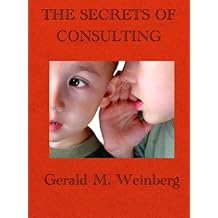
The Secrets of Consulting: A Guide to Giving and Getting Advice Successfully

by Gerald Weinberg
Copyright (c) 2011

Weinberg is a master of extracting the human personality required to run modern business. He describes one of his art-forms in this introduction to consulting practice. This book does not focus merely on short heuristics on how to consult. It instead goes in-depth into the psyche required to succeed as a consultant.

He defines consulting as the art of influencing people at their request. He then describes a rational framework for this practice and how communication can succeed through humility and the proper management of change. This latter topic (the management of change) is where Weinberg is at his best. He distills his advice in rules or laws that govern the enterprise. Often these laws seem paradoxical or unusual at first. Then he supports these laws with interesting anecdotes that bring the truth to the fore. As such, he prepares the landscape of consulting for those new to the practice. Landmines are able to be anticipated and avoided instead of exploded with pain.

At the very least, Weinberg's voice needs to be heard because of his incredible self-awareness. Instead of approaching the matter as mere science and facts, Weinberg artfully describes the human component in consulting - since it is the art of influencing people, at their request. Anyone who wants to get better at navigating the thorny roads of human feelings and human nature would benefit from reading Weinberg's take.

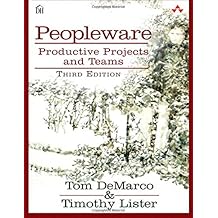
Peopleware: Productive Projects and Teams

by Tom DeMarco and Tim Lister
Copyright (c) 2013

This book is one of the few focused specifically on how to manage projects and teams of knowledge-workers. It teaches the reader how management might retain workers and their essential skills instead of treating them like cattle. It treats the central problem of management is sociology and not technology. Keeping knowledge-workers happy and productive requires humanity and not scorched-earth policies.

The book, in its third edition, is organized into 39 short chapters each with its own focus. As with most management books, its lessons are absorbed in the industry practice. Nonetheless, it is nice to read the thinking and research behind contemporary practice.

Management of people should focus not merely on the goals/objectives of a project but upon the people involved. This is a lesson which is sometimes forgotten by management. The person who works on a project/team is a knowledge worker with feelings, experience, knowledge, and wisdom. One must not only navigate the objectives of a project but also the care of a person. People work best when they are happy and not actively stressed by poor management.

The House of the Seven Gables

by Nathaniel Hawthorne
Written 1851

Hawthorne wrote this book in the warm aura of his masterpiece The Scarlet Letter. This book dwells on the theme of whether a Puritan history - replete with its sad stories like the Salem Witch Trials - will haunt the New England culture forever or whether New England can overcome such sad austerity.

The hope for the future lies in the characters of Phoebe and Hargrove, who end up getting married in this story. They are open to new ideas and open to learning from the past. They seek to experiment in new things like gardening while researching the past. They are Renaissance people for another era. They might not have the best education, but they are interested in learning and growing as people. They alone can free the New England mind (and mind you this book was written in the nineteenth century) from sterility and stagnation based on pride.

It is interesting to read this classic in my current setting in the modern American South. The New England mind of the nineteenth century is a distant and foreign concept to me. A miniature picture of its norms before the Civil War is interesting. While the Southern mind was becoming more entrenched, the New England mind was figuring out new ways to grow and expand its virtue. Puritanical idealism still exists in the American South. Perhaps we need to listen to Hawthorne more to overcome our stagnation in our contemporary setting. Perhaps we need our own Hawthorne to overcome the horrors of slavery and Jim Crow in our history and so to embrace growth.
Monday, December 17, 2018

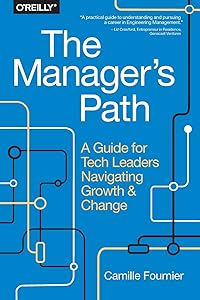
The Manager's Path: A Guide for Tech Leaders Navigating Growth and Change

by Camille Fournier
Copyright (c) 2017

My path to software was not traditional. I always did well at mathematics in school, but I liked many things that weren't technical - journalism, religion, poetry, and medicine all pulled my strings at some time. I have ended up producing software used in medical research. As such, I figured that I needed to study the traditional career path in software/technology to try to meld my diverse skill-set with more traditional steps.
Camille Fournier has provided a book that describes that path. She moves step-by-step through a typical career in technology - from first job to senior management with all the steps and choices in-between. This "bird's eye view" lets someone see the path behind them, around them, and ahead of them. As such, it can be used as a framework to enhance one's skills relevant for the longer term.

The main situation that Camille does not address at length is the non-traditional one. Those who switched from people-doctor to computer-doctor are not addressed. As technology continues to become increasingly ubiquitous around us, careers in technology will probably be wedded with other interests. It would be interesting to hear her thoughts and experiences on this matter.

Saturday, December 15, 2018

The Scarlet Letter

by Nathaniel Hawthorne
Written 1850.

I originally read this book in high school. I reread it now, with two more decades of life experience. I've lived among Christians who revere the Puritan era. I've experienced social shunning. I'm a male living in the #MeToo era where one sin of sexual harassment can lead to career demise.

In all of these situations, however, I side with Hawthorne's sympathies towards those who bear the brunt of social shunning. Or at least, I try to side. If social order must be enforced (and social order in the case of a pregnancy is an extreme but common example), then it must be enforced loosely. That's what prohibition, abortion, and the rest of the culture wars have taught us. It is foolishness to fight human nature.

At the same time, those who are persecuted are often ennobled by their suffering, as Hester Prynne and Pearl were by theirs. The Scarlet A became not a sign of Adultery but of Ability for Hester. Hawthorne holds her up as a model, and I follow her willingly against those (on whatever side of the left/right/center cultural battles) who hold that purity ought to be externally enforced all the time.

It is a tenuous foundation that we sit upon as Americans. We are often blind to the purity-seekers who more-or-less agree with us. Although we are considered a free country, we often bind up our fellow citizens in our quest for purity. Indeed, in so doing, we act like our forebears. Hawthorne reminds us of this well. Puritan New England is not that far away from us today.

Tuesday, December 11, 2018

Eliza Hamilton: The Extraordinary Life and Times of the Wife of Alexander Hamilton

by Tilar J. Mazzeo
Copyright (c) 2018

Like many, I fell in love with the protagonist of Broadway's biggest hit in recent years Hamilton. The true protagonist of that story is not Alexander Hamilton but his wife Eliza Hamilton. Her life as one of our country's founding mothers brings accolades that stack up well alongside her husband's.

She bore seven children. Mindful of her husband's past and her children's present, she helped found the country's first private orphanage. She helped raise money to fund the Washington Monument. She was close personal friends with Martha and George Washington. She was a noble "Roman wife" whose work directly helped found the United States of America. She loved her family and tolerated her enemies.

Eliza was not brilliant. That was Alexander's part. She had heart, though, and loved Alexander and her family deeply.

Most interesting is Mazzeo's take of the Reynolds affair. The way this tale is traditionally told is that Alexander, while Treasury Secretary, had a sexual tryst with a Maria Reynolds with Maria's husband's full knowledge in Eliza's bed. A love note supposedly corroborated the affair. James Reynolds, Maria's husband, supposedly blackmailed Alexander for money with the threat of telling Eliza.

But Eliza never divorced Alexander and defended him with passion for the rest of her life. Why? Mazzeo contends that Alexander falsified the Reynolds pamphlet to cover up for insider trading. She contends that politicians of his time and enemies of Hamilton's political party (including future presidents James Monroe and Thomas Jefferson) knew this and forced the brilliant Alexander out of politics. Mazzeo even outlines her theory in a closing Author's Note within the book.

Well-written and an interesting profile of one of our founding mothers, Eliza Hamilton tells a story not of a saint but of someone's interesting angle on life.

Saturday, December 8, 2018

Let Her Fly: A Father's Journey

by Ziauddin Yousafzai (father of Malala)
Copyright (c) 2018

Malala, Ziauddin's daughter, is an awardee of the Nobel Peace Prize for advocating for girls' education. She paid for this cause by being shot in the face by the Taliban. Her father, living in the midst of a highly patriarchal culture, sought to lead his family in an egalitarian manner while running a school for girls in Pakistan.

Malala's story has been well-told in her best-selling book I Am Malala. Her father's story is told here. It brought tears and warmth to my heart. I appreciate a good father's heart, and this fellow definitely has that. What's more is that he has a tale - filled with near-death, courage, redemption, and love - to support that heart.

What's most interesting in Ziauddin's journey that inspired him to have an egalitarian household. He married a wife who desired equality, but he lived in a culture which systematically denegrates women's place. Nonetheless, Ziauddin came to value education and its ever-present value of equality.

This is a good read for anyone of any culture interested in learning what fatherhood is all about. Ziauddin exhibits that role to the utmost and deserves our respect. It takes courage to live the life he's lived, both in the public sphere and in the private sphere. Credit to journalist Louise Carpenter for sharing this story with the English-speaking world.

Thursday, December 6, 2018

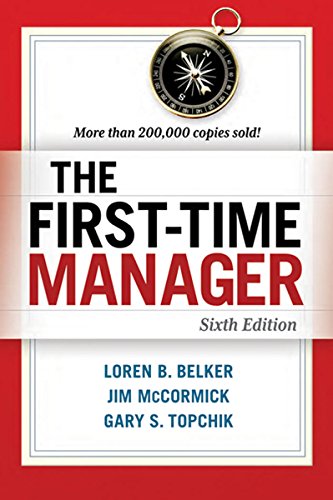
The First-Time Manager

by Loren B. Belker, Jim McCorkmick, and Gary S. Topchik
Copyright (c) 2012
Audiobook

I am not a first-time manager. I am not even a manager. Nonetheless, studying the field of management can give me insight into my work. It can help me work better with the managers around me, and it can help me carry my load as a manage my projects in tandem with the people around me.

This book consists of tips and insights for those transitioning into the role of a manager. It provide indispensable sage advice to avoid common pitfalls. It is field agnostic; that is, it does not focus on only the healthcare industry or only the technology industry. As such, it conveys a generalist message for a general audience.

Some of the advice, then, does not make sense for my position in healthcare or technology. Both of those fields allow team members ("reports") to have a great deal of independence in their work. That autonomy changes some of the dynamics of management. Indeed, sometimes the highest-paid (and most-valued) employee is not the manager. This all speaks to the notion that reports may be the most important contributors and need to know how management functions. Which is why I read this book.

Wednesday, December 5, 2018

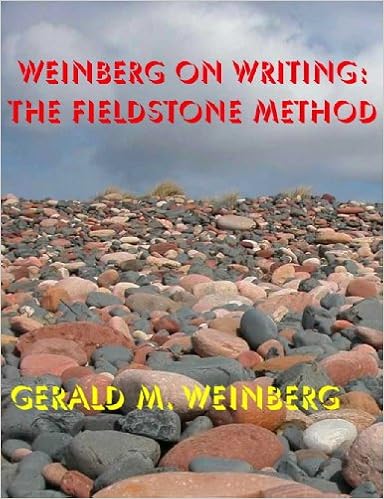
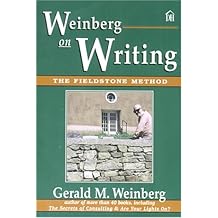
Weinberg on Writing: The Fieldstone Method

by Gerald M. Weinberg
Copyright (c) 2011

Gerry Weinberg has a PhD in communications and has written around 60 books on various topics, mostly having to do with computer programming. As a glorified computer programmer and an aspiring writer, this Weinberg book on his methodology for writing seems appealing.

His basic take runs through writing from the heart. He uses the analogy for nineteen of twenty chapters in this book of craftsperson building a wall with "fieldstones" and mortar.

For example, the act of sorting stones into piles is compared with sorting one's ideas into working projects. Many ideas, like many stones, are to be thrown away. Some are meant for placement in one section; some are meant for placement in others. All require careful arrangement.

I like how Weinberg's process is highly non-linear, much like the way I think. I tend to accomplish more through the use of non-linear thinking. (Aren't all good minds essentially non-linear?) I also appreciate the spatial metaphors he uses as I find the linear way I was taught to write in high school to be very confusing.

I write words like I write code - in a blow-off-the-doors, mad rush to dump out my thoughts onto a keyboard. Fitting in a linear process does not really work well for me, whether that be in a manager's linear model (waterfall methodology anyone?) or in an English teacher's ploy for high test grades. I do best when I just make a quick dump and organize as I go. This seems to be how Weinberg teaches us how to communicate as well. That confidence in a method that fits me enables me to write more recklessly and with more moxie than I would otherwise. For that, I am grateful to have read this book.

Monday, December 3, 2018

Jane Eyre

by Charlotte Bronte
First published 1847.

Jane Eyre was and is a classic of the English language. Originally published part-way through the Victorian era, this book tells a story of a woman who lost her parents to an early death and was raised and educated in an orphan's asylum. (It is important to note that this was before the rise of the welfare state in Britain and before public education was recognized as a right.) Her best friend at her school died an early, but not unusual, death.

Jane ended up becoming a governess of a house upon her graduation. The owner of the house falls in love with her, and she with him. They engage to be married, but a surprise greets them on their wedding day. Not willing to compromise the sanctity of their marriage, Jane runs away without her worldly possessions. She is found in a near-death-like state by another family and is taken in by them.

Eventually, the oldest brother of this family asks Jane to marry him, but Jane refuses. He is bound to become a missionary in India, and Jane, though willing to go to India even if it means a sure death, refuses to marry him because they do not love each other. In her words, "cold"-ness and "ambition" drive him, not love.

Circumstances align for Jane soon thereafter. I will not spoil the ending for you, but it is a tale of redemption, my favorite archetype in literature. Perhaps my story as well might be redeemed.

Thursday, November 29, 2018

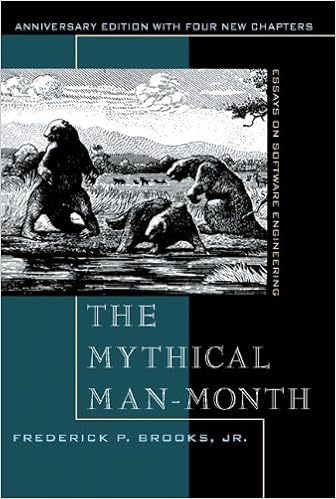
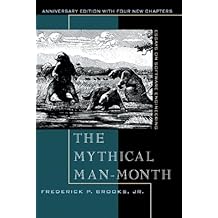
The Mythical Man-Month: Essays on Software Engineering

by Frederick P. Brooks
Copyright (c) 1995

What is relevant about a book, in its second edition, that was originally written a generation or two ago about managing computer projects? The author Brooks led the management of the project for IBM decades ago.

The answer to this question is simple and is evident in the title. Scaling software projects from smaller-to-larger does not scale linearly. In case you don't know what this means, scaling non-linearly means that a project twice as big does not require twice as many "man-months." It more likely requires four times as many "man-months" because of the need for communication among programmers.

Brooks shows the aged wisdom of the idea that computer programming is indeed part communication and not fully mathematical problem solving. Brooks then tries to figure out how to manage projects that are larger and that require more communication. Many of the references are aged and not for those who don't appreciate the history of computation. Nonetheless, for those who like to dabble in history, Brooks' take - always bright - makes us see that the problem of successfully managing software projects is not a new one. Indeed, there are timeless values which undergird technical success.

This anniversary edition includes a retrospective account that evaluates many of the propositions originally put forth decades ago. (Brooks was mostly right, we see.) However, I wish Brooks would also lend some ink - in the light of the additional experience of a couple of decades - to the questions of what makes a software project successful in the first place. Merely being right should fade while understanding timeless values should come to the fore.

Monday, November 26, 2018

The Life of Thomas More

by Peter Ackroyd
Copyright (c) 1998

Thomas More is one of the few beatified English lay-persons in history. He was beheaded for resisting the coming Protestant Reformation. What comes around, goes around, however; More, in the years before King Henry's divorce of Catherine of Aragon, oversaw the exercise of the death penalty to several Protestant heretics. He stood, as Ackroyd tells it, for the old way of medieval Christendom. He was unwilling to accommodate the Reformers' ways of change in England. He refused to take an oath of conformity that King Henry was the Head of the Church in England and did not speak about the King's divorce. His silence spoke louder than any words and led to his untimely death.

Of course, he famously remained silent on Henry's second marriage and paid the price for it. He saw the old ways of Natural Law and reason as the true ways and was not afraid of dying for it. One wonders what More would say about the coming bloody purges in English Christianity, with Bloody Mary, Fox's Book of Martyrs, and Queen Elizabeth.

An American reader cannot help but note the contrast between European Christianity and American Christianity. European Christianity is tied inexorably to the state whereas American Christianity, formed in the incubator of the separation of Church and state, is more of a creative and progressive force in American history - at least until the resurgence of the fundamentalists in the second half of the twentieth century. Reading a biography like More's induces a longing for atheism and freedom from religion - despite the fact that religious piety animated this man's silence towards Henry.

One can only wonder if American Christianity is capable of producing a Thomas More given our predilections against the intermixing of church and state. In no small thanks to More, conscientious objectors no longer face death penalties (although alternate service could still be debilitating). Such character would stand out in any nation's history. Natural Law and reason are popular in present-day conservative circles, especially among intellectuals, but popular conservatism seems antithetical to More-like principle-driven action. More stood for a passing medieval order; for that, he deserves our pity. But for the fact that he still stood tall and silent until his guilty sentence, he deserves our sympathetic admiration.

Resources to Explore: History

The Historiography of Contemporary Science, Technology, and Medicine edited by Ronald E. Doel and Thomas Soderqvist

Technology in America: A History of Individuals and Ideas edited by Carroll Pursell and Merritt Roe Smith

Thursday, November 22, 2018

Refactoring: Improving the Design of Existing Code

by Martin Folwer
Copyright (c) 1999

I picked up this book at the wrong time. The book was so successful that a second edition is due out on November 30, 2018 (less than two weeks from now).

On the other hand, I picked up this book at the right time. At work, my project is in the midst of a refactoring project. I am in the middle of changing PHP code from modular functions to object-orientation. The aim of this transition is to enhance the scalability of the project and ease the writing of documentation. I generally like to peer "beneath the surface" of skills that I acquire; this book has indeed enlightened my mind to details of what is going on in my code rewrite.

Some of this book is incredibly tedious. It details how to change code from one format to another. It's work that I let my fingers do more of - and my brain less of! But the book also frames how to do this work and why it is so important. It ties together intellectual "loose ends" which might not be tied together by the programmer who simply dives "head first" into the project.

Fowler writes in tandem with a research seminar at the University of Illinois who have pioneered object-oriented techniques in Smalltalk and then Java and C++. They tackle the concepts of refactoring more than how to tackle the specifics of coding in a language. I prefer their theoretical approach to more common approaches drenched in technical lingo and programming tools. This book was worth its time.

Einstein: His Life and Universe

by Walter Isaacson
Copyright (c) 2007.

This book, based upon recent public releases of Einstein's private letters, provides a more intimate portrait of Einstein than has been possible before recent years. Einstein's prowess as an intellectual and a scholar is well-known. His closest relationships - with his sons, both of his wives, and his daughters - has not been well-known.

What do we discover from this in-depth look at the man who helped set the course of the twentieth century? We see a man engrossed in his studies of physics; we see a man who cared deeply about the people around him; we see a man who is sometimes aloof to interpersonal affects as well as to geopolitics; we see a man who is warm yet deeply wedded to his theoretical physics work; we see a man thoroughly defeated when it came to quantum mechanics; we see a man who is, in many respects, like all of us.

This man of 112 Mercer Street in Princeton taught the world the rules of the universe. Then he taught the world more deeply by his manner. He fought for what he thought was right to the end and stubbornly refused to admit defeat in the realm of world government or the nature of reality. This portrait provides us with intimate access to a genius - intimate access that, until 2007, was simply not possible. For that alone (besides being a well-written account from one of our best English-language historians), it deserves our attention.

Friday, November 16, 2018

Resources to Explore: Software


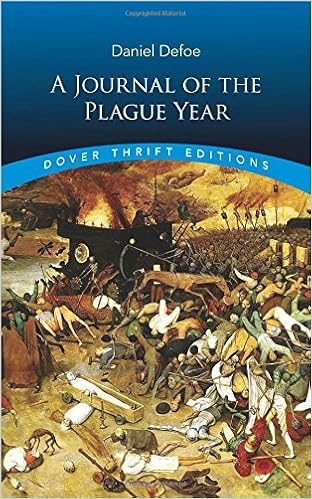
A Journal of the Plague Year

by Daniel Defoe
Written 1722

The years 1665-1666 were rough for London. 1665 brought plague, and 1666 brought a city-wide fire. This book contains a fictionalized account of that plague year of 1665. Defoe, writing 50+ years hence, constructed a narrative based upon research in journals from that era. In providing an account of these interesting times, this book provides several interesting interludes. Like the story of a naked Quaker who walked the streets. Or how the poor and city officers bravely attacked the disease to make the city function.

It is always interesting to study British history through the lens of class. Ironically, the clergy and the well-to-do did not confront the illness with as much braveness as the lower classes. Although the poor suffered most from the disease (think of the close living quarters in pre-Industrial-Revolution London), they were less paralyzed by fear of the "distemper." Remember that people at that time did not know that the plague was caused by rats. They just knew that it was a "contagion" that was transmitted in an area. For all they knew, it was an act of God's displeasure upon London, not a relatively random event in the history of bacteria!

Fear, courage, and madness are all on display in this dystopian tale. One cannot help but wonder how modern London would respond to a similar crisis. We have record of an Ebola outbreak in recent years in Africa to compare to. That public health crisis was not handled too well by the international community. Fortunately, London now has a public health system that can respond to emergent outbreaks with speed and skill. Perhaps that prevention is the lesson of the plague year for us. We do not suffer these kind of events commonly because we attend to their prevention in the early stages of problems. What of our problems will those 300 years from now read and wonder about in the pages of our literature? One can only dream...

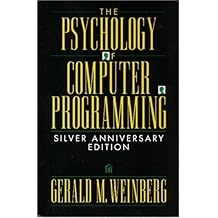
The Psychology of Computer Programming: Silver Anniversary Edition

by Gerald M. Weinberg
Copyright (c) 1998, 1971

This book is misnamed, as the author admits. It should be named "The Anthropology of Computer Programming." It studies the culture of computer programming rather than the psychology of the practice. Fortunately, despite being written over forty years ago, it succeeds at its task for the reader today as well as for the original reader.

If you can move past the references to dated languages and programming practices, this book elucidates many observations about how programmers work. It's like reading an anthropology of a long-hidden culture from decades ago. From one who works in computer programming, the cultural fruit of these observations can be seen in labs today.

To be frank, I've never felt that I've truly understood my peers in the lab. I've done well with the computer - with expressing myself through programs. So many of my peers are socially passive in their demeanor. I'm outgoing, even energetic. The cultural analysis in this book, though dated, helps me see this culture more clearly. It helps me feel more at home in my own environment - and perhaps also, in my own skin. As such, this book achieved its goal in my life, and for that, I am sincerely grateful.

Sunday, November 4, 2018

The Invisible Plague: The Rise of Mental Illness from 1750 to the Present

by E. Fuller Torrey and Judy Miller
(c) Copyright 2002.

This book, written in part by a psychiatrist with expert knowledge of schizophrenia, addresses the question of why mental illness has become increasingly pervasive since 1750. Starting with this date and proceeding towards the present, Torrey and Miller make a commanding case that the prevalence of mental illness has increased steadily since the age of Enlightenment, at least in English-speaking countries. The argument is forceful.

They argue against the common argument - pushed forward by many in prominence like Michel Foucault - that the diagnosis of insanity/psychosis is merely a way of pushing away societal nonconformists into asylums. The finding of MRI changes in those with bipolar disorder or schizophrenia, for one, argues for some kind of biology of disease, not merely a sociology. Further, the contention that genetics provides a key does not answer the question: What in modernity has led to the spread of mental diseases? Why did we not see this prior to 1750?
The authors propose a wide variety of possible (but unconfirmed) causes, all centered around the hypothesis that urbanization plays a key role. This case is well-argued and deserves attention and research.

Resources to Explore: Healthcare, Children's


Robinson Crusoe by Daniel Defoe

Saturday, November 3, 2018

Information Dashboard Design: Displaying data for at-a-glance monitoring

by Stephen Few
(c) Copyright 2013.

Dashboards are a hot topic in our information-laden world. They are imagined by those in the design world (often very poorly) and implemented by programmers who do not take their imagination any further. This book, written by an acknowledged expert in the field of visualization, describes how to design dashboards that communicate essential data to users, mostly business-people. As such, its audience consists of designers, not programmers. Although I am a programmer, I enjoy "cross-training" my imagination by thinking in the intellectual "boxes" or "bins" of those around me.

Few introduces standard graphs and a couple new ones (bullet graphs and sparklines). He explains the use of each in standard fashion. His real contribution, after explaining the fairly standard song-and-dance, is through the introduction of these new graphs, one of which he invented. I was curious to try to implement these two graphs using R's ggplot. Although I have no immediate use for these types of graphs, it's nice to have new tools in the box of memory to explain people's data accurately and effectively.

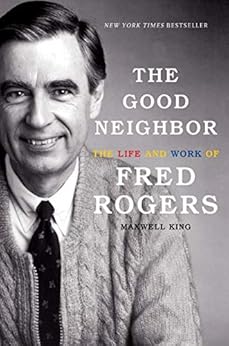
The Good Neighbor: The Life and Work of Fred Rogers

by Maxwell King
Audiobook

Fred Rogers, a.k.a. Mr Rogers, grew up the son of a rich businessman, majored in music at college, got into television in the early years of NBC, studied at seminary to become a Presbyterian minister, started children's television at the Canadian Broadcasting Corporation in Toronto, and extended children's television into education with PBS. He is fondly remembered as being extraordinarily patient with children just by being himself. A generation of children - ok, maybe several generations of children - spend some of their earliest years being taught by this man about emotional intelligence and social formation. His work continues on to this day through the cartoon Daniel Tiger.

This book skillfully tells the story of his life, beginning as a sensitive young boy until his life as a retired king of broadcasting. It explains the quirks of his personality at every turn. It pays particular homage to his intellectual formation as a musician and as a seminarian studying child development under Dr. McFarland. Rogers incorporated facets from all parts of his life into his work and show. That is how he shared his creative genius with the world.

For those who have already been touched by the life and work of Fred Rogers, this book will bring back memories of learning under this influential man. For those who are not familiar with him, it will educate you on how a life - a male life, nonetheless - can be so fully dedicated to the well-being of children. Rogers thought it immoral to manipulate an innocent child through commercials and did not fully capitalize on his work. (Of course, he was born independently wealthy.) His idealism and kind goodness is well transmitted to the reader - or the listener - through this book.

Sunday, October 28, 2018

The Confession of St. Patrick

Translated by Charles H. Wright
Fifth century C.E.

Saint Patrick, the patron saint of Ireland, was a British heathen-turned-missionary who spent his life "civilizing" or "Christianizing" the Irish. Though affiliated with the Roman church, Patrick was remarkably free of scholastic learning. As such, he represents a distinct wing of the church's intellectual tradition. While the Western church was becoming other-worldly (and overbearing), Patrick and his Irish converts emphasized the worldly usefulness of faith.

This confession was reportedly spoken and written before Patrick's death. It contains the summarized story of his life, replete with visions, miracles, and all sorts of things offensive to many modern and scientific minds. Even if we can provide more naturalistic descriptions to Patrick's spiritualism (aren't dreams merely a projection of our subconscious?), we must respect his action. To act, not to speak precisely, is the ultimate mark of a human being making the most of life. Patrick certainly acted. He converted an island to his perspective - and to Patrick, God's perspective.

The Irish eventually paid an influential and oversized role in preserving ancient civilizations like that of Greece and Rome. Their monasteries preserved much of the writings that inform us of those traditions. While the continent was wasting away in ignorance, Patrick's spiritual optimism allowed a mini-Renaissance to flourish in Ireland. For that, we all are grateful. Patrick seemed to march to the beat of his own drum. Fortunately, by the end of his life and by the time of this writing, more began to hear its rump-pa-pum-pum.

Saturday, October 27, 2018

Resources to Explore: Software

The Elements of Programming Style by Brian W. Kernighan and P.J. Plauger

Literate Programming by Donald E. Knuth


Code Complete: A Practical Handbook of Software Construction

by Steve McConnell
Copyright (c) 2004

Code Complete is a 850-page tome which might serve as Computer Science guru-author Steve McConnell's magnum opus. His presentation addresses an audience that spans programmers at the beginning level, intermediate level, and advanced level. With its wide-ranging scope, it fills in  any computer scientist's holes of knowledge.

Units are filled with a handful of chapters each and consist of foundations, producing high-quality code, variables, statements, improvements, systemic issues, and craftsmanship. McConnell aims and succeeds at addressing core issues of how software is actually constructed.

I appreciate how much he addresses the team aspect of computer science. For me, this has been lacking in my education. I've worked hard at developing computer programming as a mathematical exercise. McConnell seems to conceptualize the practice more as a sports team, with individuals at varying degrees of core competencies and varying types of skills. As such, he puts forth ideas as computer code as communication in a forceful (again, 850 pages, 35 chapters) approach that I have not read or seen before.

The book is well-researched with frequent citations of studies, books, and papers. It attempts to bring its recommendations with hard facts, not simply sage advice. Further, it provides bibliographies at the end of every chapter with recommendations for further reading. I find that computer scientists are traditionally weak when it comes to reading the literature, and this type of book-list is hard to find. As one who learns best by close, quiet reading, I appreciate the well-commented references.

Thursday, October 25, 2018

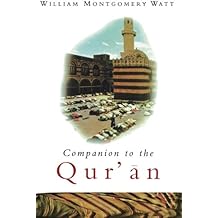
Companion to the Quran

by William Montgomery Watt
Copyright (c) 1967, 1994.

It's interesting to become a voyeur into other religions. I see how much of Islam is quite similar to Christian fundamentalism - subjugation to a text, promises or threats of an afterlife, and a general lack of humanism. Perhaps this belies my Christian theological orientation more. I don't really like Christian fundamentalism, nor do I like the Koran much.

I respect Muslims, and I mean them no harm. I just disagree with them that this is the meaning of life. I prefer the Christian story of grace and redemption. I wish to understand Muslims as they are my neighbor, whom I am commanded to love. That is why I read this Companion to the Koran. The scientist in me wants to understand the world around me; the religious side of me wants to learn how to love and respect Muslims more; the seeker in me wishes to understand what this book, so revered, has to contribute to a common human instinct to seek after God.

I leave my reading of this guide grateful that Islam has been in geographic retreat since 1666. Perhaps I should feel the same way about Christianity if I only read one commentary on the Bible instead of hundreds of books of theology. The Bible must come alive to be understood. That's why I like reading the history of religious activities alongside my Bible. The Koran must be the same way. One must first be oriented to learn deeply about the religion. I lack that deep learning - that life habituation - to understand this great book. In my ignorance, I find little compelling here, but I am open to learning more.

Wednesday, October 24, 2018

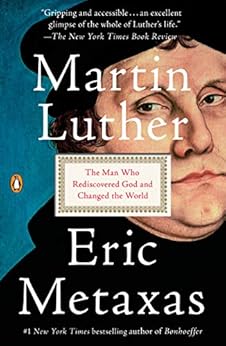
Martin Luther: The Man who Rediscovered God and Changed the World

by Eric Metaxas
Copyright (c) 2017.
Audiobook

Martin Luther's life is controversial any way you cut it. Fundamentalists (with whom Metaxas is sympathetic) like to claim Luther as one of their own because of his insistence on Scriptural primacy. (They like to call it Scriptural authority, but such concepts were not present within Luther's writings.)

Liberals like to claim him because he broke free from institutional chains to usher in the freedom which founded to modern world. Unfortunately, liberals have to grapple with the later Luther who was a grouchy anti-Semite. (His earlier writings actually leaned pro-Jew.)

Twentieth-century Nazis claimed Luther because of this anti-Semitism. Hitler used Luther in the name of a German nationalism to communicate lies of Aryan supremacy.

In truth, Luther is none of these. Martin Luther is a late-medieval monk who rebelled against Roman authority. This book tells his story well. His rebellion led to the founding of Western freedom. As Metaxas chronicles, his 95 Theses directly brought about the modern world. Where other Christian reformers - such as John Huss - failed, Luther succeeded, due in no small part to the technological advancement of Gutenberg's printing press. Protestantism's success laid a foundation for the American Revolution, which laid a foundation for the spread of democracy around the world. All from nailing a document to a wall for scholarly debate.

Unfortunately, Luther's (and Protestantism's) legacy is still mixed. The church universal is split to pieces because of Luther's inability to agree with other Reformers' views on the Lord's Supper at Augsburg. Luther believed that Christ was present bodily in the communion elements while others viewed it as a spiritual or even allegorical presence. No united front against the Roman church came about in Luther's life, and such continues to this day.

Luther is one of those towering people in history that everyone should know a little something about. This book, though thick, can enlighten readers about this controversial yet impactful humble monk.

Resources to Explore: Software


How to Solve It: Modern Heuristics by Zbigniew Michalewicz and David B. Fogel


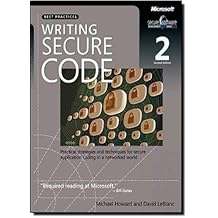
Writing Secure Code by Michael Howard and David LeBlanc


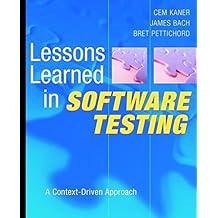
Lessons Learned in Software Testing by Cem Kaner, James Boach, and Bret Pettichord

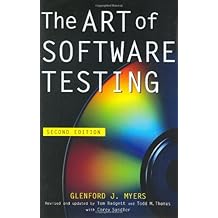
The Art of Software Testing by Glenford J. Myers


Web Performance Tuning by Patrick Killelea

Software Cost Estimation with Cocomo II by Barry W. Boehm et al.


Peopleware: Productive Projects and Teams by Tom DeMarco and Timothy Lister

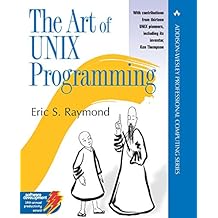
The Art of UNIX Programming by Eric S. Raymond

Review: How To Write a Simple Book Review: It's easier than you think

How To Write a Simple Book Review: It's easier than you think by Allyson R. Abbott My rating: 3 of 5 stars ...